You already have the film in your head.
Nabu holds the rest of it together.
Story-aware screenwriting software that gets you to the last page. Work out the scenes on the corkboard, write the pages, and let Nabu keep track of continuity and threads.
Private alpha. By invitation.
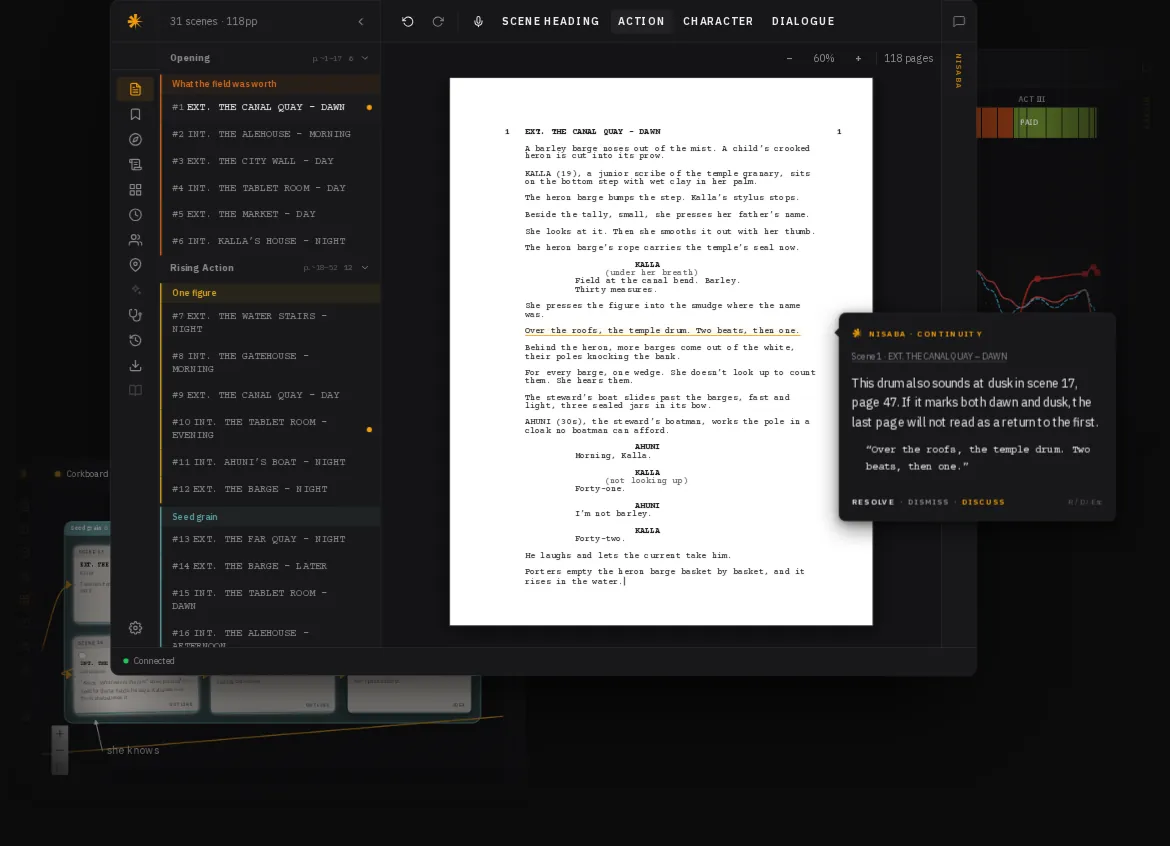
EXT. THE CANAL QUAY – DAWN
A barley barge noses out of the mist. A child’s crooked heron is cut into its prow.
KALLA (19), a junior scribe of the temple granary, sits on the bottom step with wet clay in her palm.
The heron barge bumps the step. Kalla’s stylus stops.
Beside the tally, small, she presses her father’s name.
She looks at it. Then she smooths it out with her thumb.
The heron barge’s rope carries the temple’s seal now.
KALLA
(under her breath)
Field at the canal bend. Barley. Thirty measures.
She presses the figure into the smudge where the name was.
Over the roofs, the temple drum. Two beats, then one.
Behind the heron, more barges come out of the white, their poles knocking the bank.
For every barge, one wedge. She doesn’t look up to count them. She hears them.
The steward’s boat slides past the barges, fast and light, three sealed jars in its bow.
AHUNI (30s), the steward’s boatman, works the pole in a cloak no boatman can afford.
AHUNI
Morning, Kalla.
KALLA
(not looking up)
Forty-one.
AHUNI
I’m not barley.
KALLA
Forty-two.
He laughs and lets the current take him.
Porters empty the heron barge basket by basket, and it rises in the water.
Scene 1 · EXT. THE CANAL QUAY – DAWN
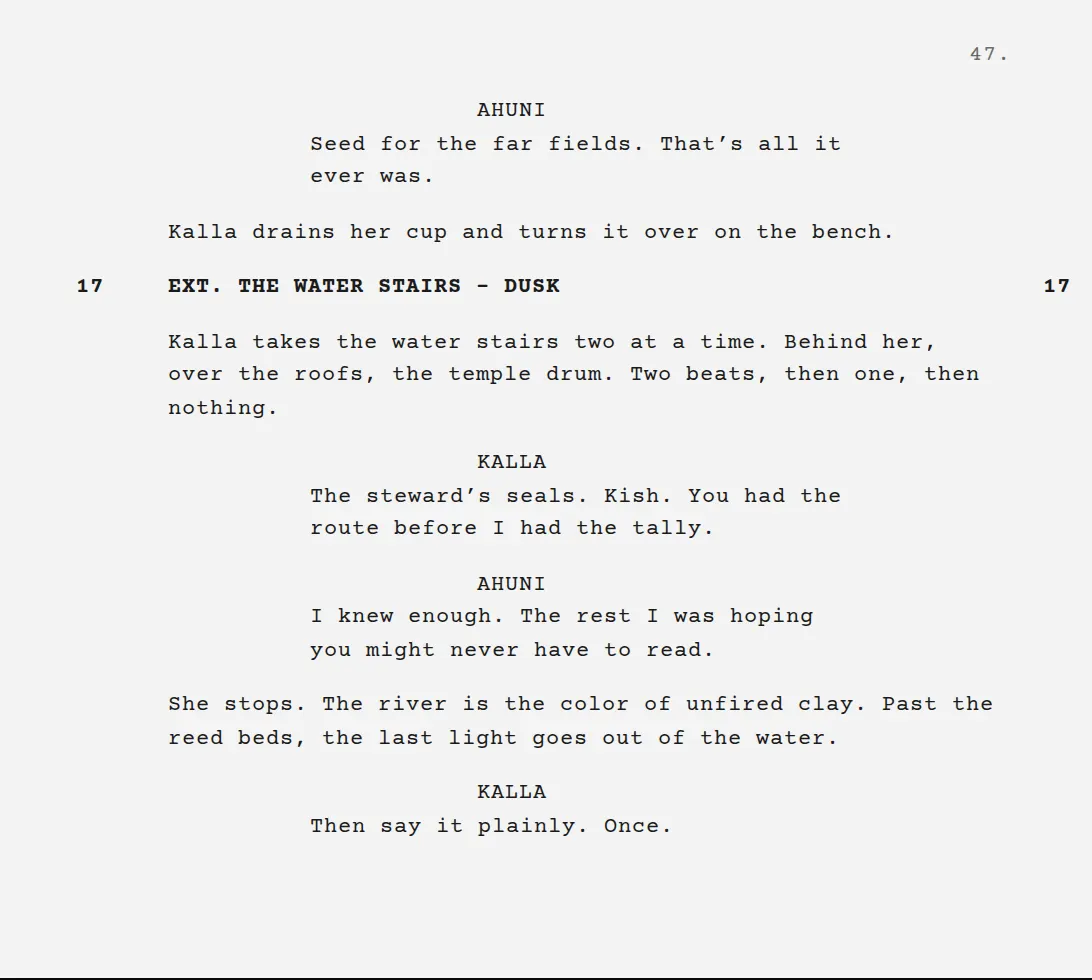
This drum also sounds at dusk in scene 17, page 47. If it marks both dawn and dusk, the last page will not read as a return to the first.
“Over the roofs, the temple drum. Two beats, then one.”
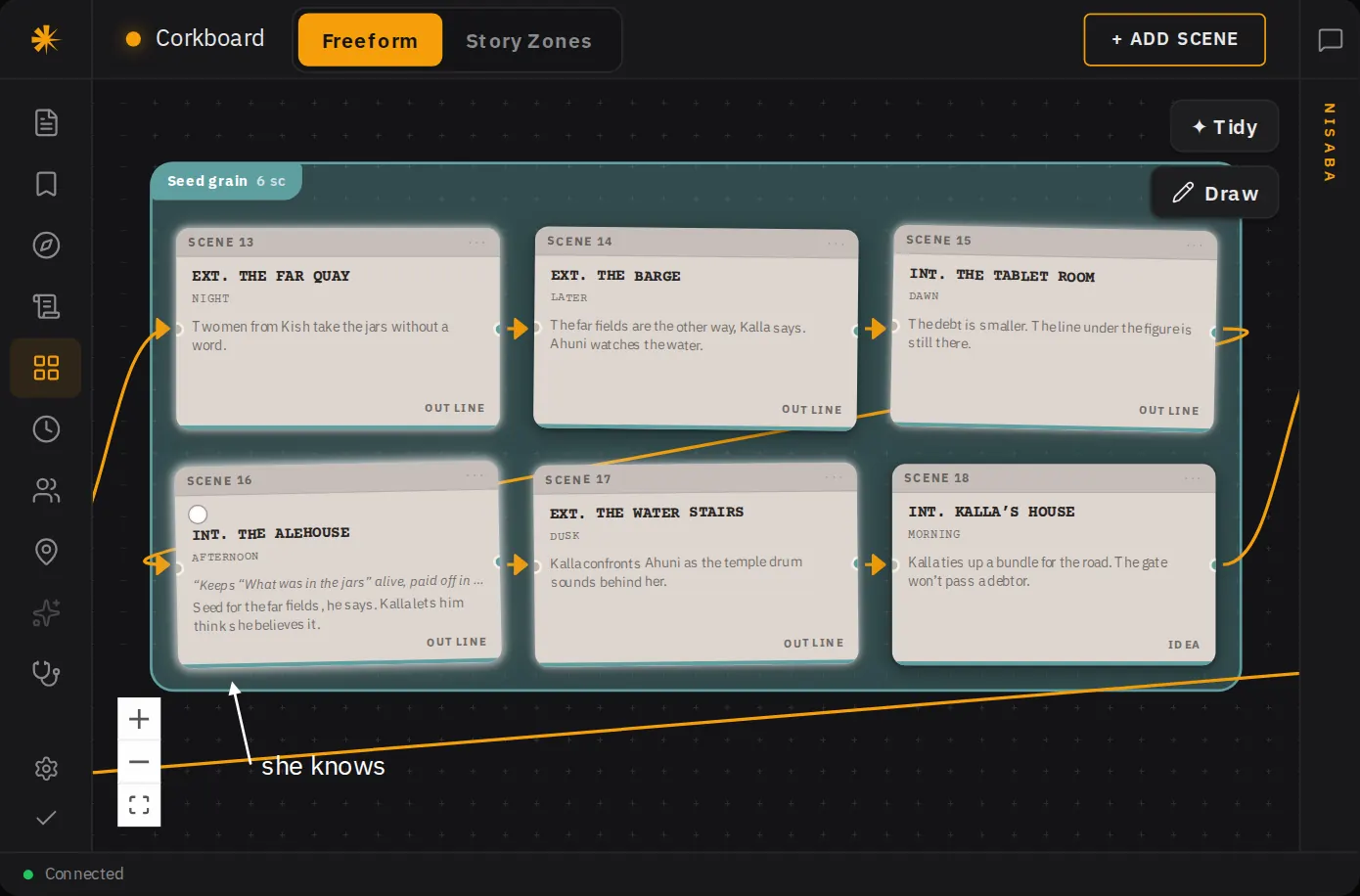
They stay linked, so you can start from any of them and trace it back through the whole story.
A note opens its passage. Scene 17, page 47: the note’s passage is marked on the page.
Sc. 1 sets up “The temple drum”, paid off in Sc. 31.
- Sc. 1 – EXT. THE CANAL QUAY
Over the roofs, the temple drum. Two beats, then one.
- Sc. 17 – EXT. THE WATER STAIRS
Behind her, over the roofs, the temple drum. Two beats, then one, then nothing.
- Sc. 29 – EXT. THE WATER STAIRS
She turns around. Over the roofs, the temple drum.
- Sc. 31 – EXT. THE CANAL QUAY
Over the roofs, the temple drum. Two beats, then one, then gone.
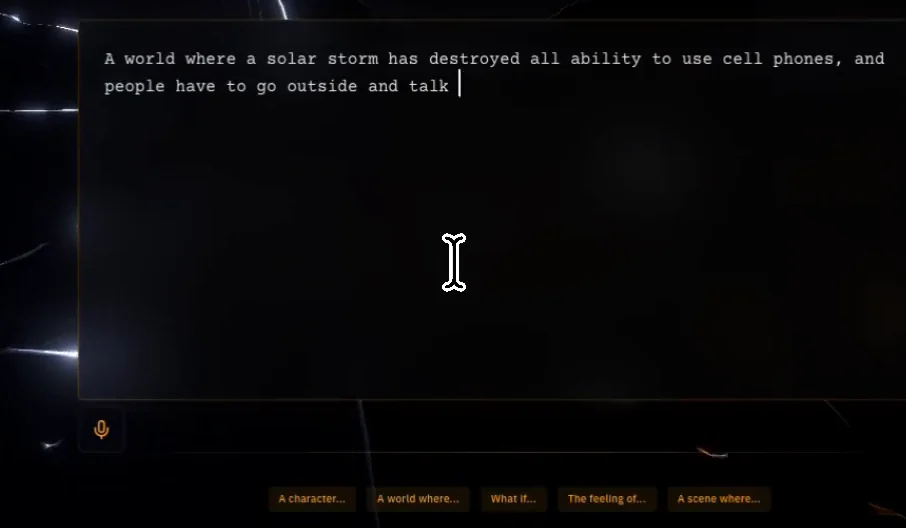
Start with a premise, a character, a scene or a question. Nabu’s guided development takes you through a synopsis, a treatment, sequences and a scene-by-scene plan.


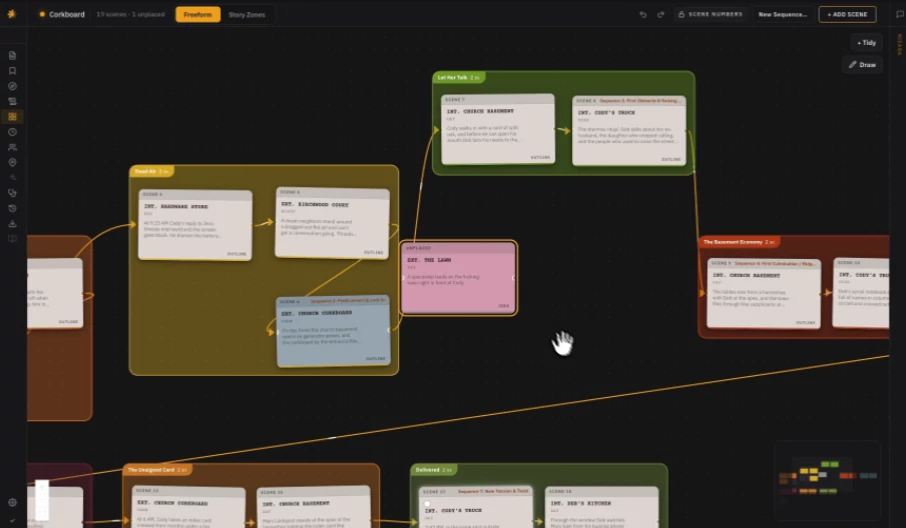

Use the microphone button to stop or replay.Tap to explore

- Every element on a key.
- Enter and Tab walk from one element to the next, and ⌘1 to ⌘6 set any of them.
- Dual dialogue.
- ⌘D pairs a character’s line with the one before it.
- Scenes and sequences.
- The navigator follows your sequences, and ⌘G goes to any page or scene.
- In and out.
- Final Draft, Fountain and PDF import and export.
- Multiplayer. Coming soon
- Write the same draft together, with a co-writer or anyone making the film with you.
Nabu tracks continuity, each character’s voice, and the story threads, and shows you where a setup is still waiting.

The passage is underlined in the note’s color, with the note beside it.

Hover or select an underline to bring its note forward.Tap to explore
Track each story thread throughout the screenplay. You always know where you’re going and what still needs to be paid off.

Hover a thread to light its scenes.Tap to explore
Nabu builds a voice fingerprint from a character’s dialogue and marks where the voice drifts.

Pick a character, or open Dialogue to read their lines.Tap to explore

We’re filmmakers. We’ve always had stories we’d love to tell, but we’ve had moments where we felt too intimidated by the craft of screenwriting to reach the last page, or sometimes even to begin.
Forming our film idea into a structure, arcs and sequences, and keeping everything moving while holding continuity solid seemed like impossible tasks. So, we built Nabu to help.
We built this tool for us. And you.
Something else? Write to us.
Can I start from an idea instead of a draft?
Yes. Nabu’s guided development can start from a character, a scene, a question, or a single sentence.
Can I bring in a screenplay I’ve already started?
Yes. Import a Final Draft, Fountain or PDF screenplay and keep writing it in Nabu.
Can I use Nabu just to write?
Yes. The screenplay editor stands on its own, and the board and the story tools are there when you want them.
How does dictation work?
Turn on the microphone in the editor and speak the scene. Say “new scene”, “character Kalla” or “scratch that” to steer it, and “done” to have what you said cleaned up into formatted pages.
What does Vomit draft do?
It quiets the interface while you write. Afterwards Nabu cleans up the draft and fills in the scene, character and arc details.
Can I write with someone else?
Multiplayer is coming. Until then, you can export a draft as Final Draft, Fountain or PDF to share it.
What do I need to use it?
A web browser. Nabu works on a computer, a tablet or a phone, with nothing to install. A macOS app is coming.
How do I get in?
Nabu is in private alpha, by invitation. Request early access and tell us about your film.
Nabu is story-aware screenwriting software that gets you to the last page.
Private alpha. By invitation.
Already invited? Sign in